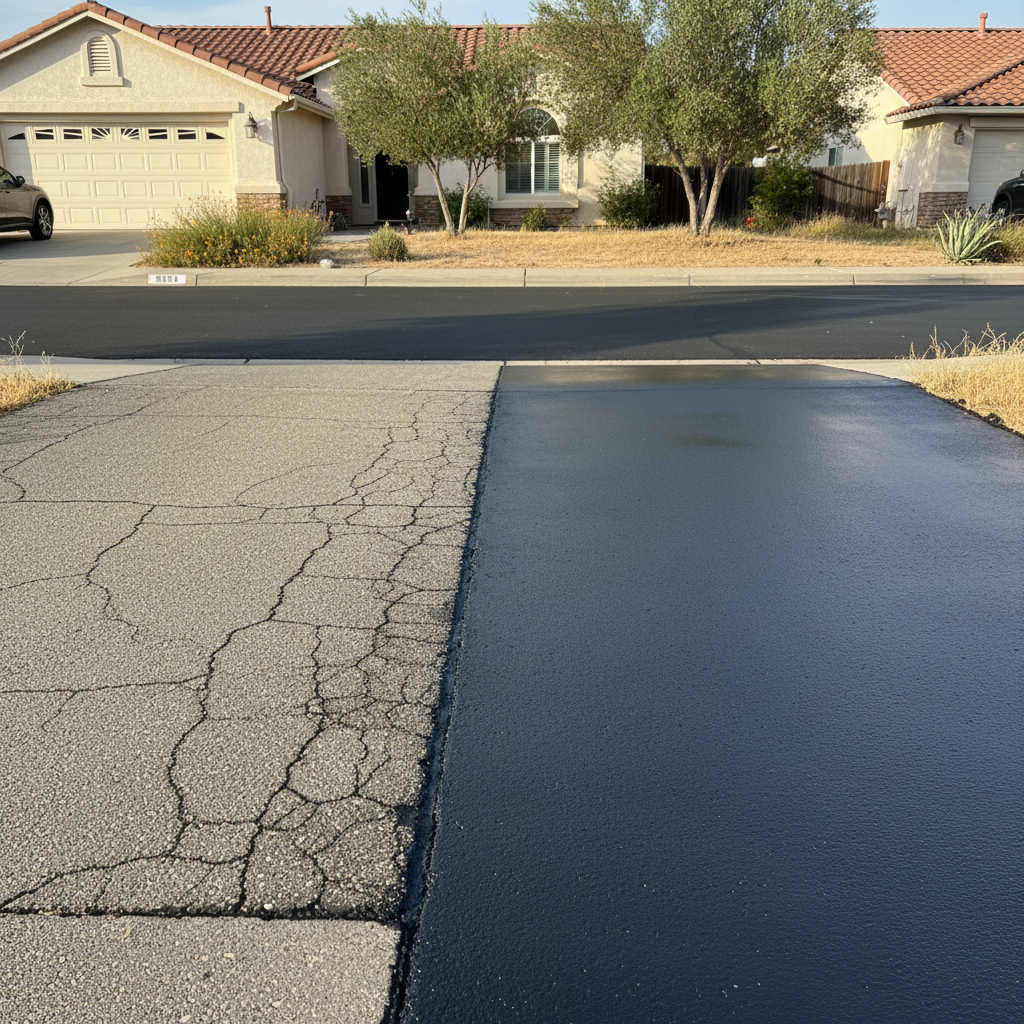
Spray vs. Squeegee: What's the Difference?
So, you're thinking about sealcoating your asphalt driveway right here in Tracy. Smart move. It's truly one of the best things you can do to protect your investment, especially with our scorching summers and those heavy rains that occasionally roll through, really beating up pavement. But when you start getting quotes, you'll hear about two main ways to put it down: spray and squeegee. What's the real deal, and which one makes more sense for your home?
I've been in this business for a good long while, and I've watched both methods in action — sometimes done beautifully, sometimes, well, not so much. Let's dig into the details.
Spray Application: Quick and Even
Spray application is pretty much what it sounds like. We use special gear to spray the sealcoat onto your driveway. Picture it like painting, but with a big, powerful sprayer. It's fast, especially on bigger driveways, and it can give you a really uniform, smooth finish if the person doing it knows what they're doing. A good technician can get a super consistent thickness across the whole surface, which is crucial for how evenly it wears over time.
One of the big pluses of spraying is that it usually uses a thinner, more liquid sealcoat material. This lets us get a very fine, even coat. It looks fantastic when it's done, giving you that deep, dark black finish that makes your driveway look brand new. For homeowners in newer neighborhoods, maybe out in the Ellis area, where driveways are often wide and pretty flat, spraying can be a super efficient and effective way to go.
The Downsides of Spray
Now, it's not all perfect. The main problem with spraying is it doesn't push the material down into the tiny cracks and pores of the asphalt as well as a squeegee does. It mostly just lays a protective layer on top. If your asphalt is a bit older, has some minor surface cracks, or is just generally more porous, a spray coat might not get deep enough to give you the best long-term protection. You know?
Also, overspray can be a real headache if the crew isn't careful. Nobody wants black specks on their garage door, house siding, or landscaping. A good company like Alpha Asphalt Tracy will always take precautions, taping off sensitive spots, but it's definitely something to keep in mind.
Squeegee Application: Durability and Penetration
The squeegee method involves pouring the sealcoat directly onto the asphalt, then spreading it around with a large, heavy-duty squeegee. This way is more labor-intensive and generally slower, but it offers some clear advantages, especially for certain kinds of driveways.
When you push the sealcoat with a squeegee, you're actually forcing that material right down into the asphalt's surface. It fills those tiny voids and hairline cracks much better than spraying ever could. This creates a stronger bond and a more durable, longer-lasting protective layer. The material we use for squeegee application is often a bit thicker, too, which helps with that enhanced penetration and protection.
For older driveways, or ones that have really seen some action — maybe those in some of the more established parts of Tracy, like around Central Valley High, where driveways might be a bit older and have endured more years of sun and traffic — a squeegee application can truly extend your pavement's life.
The Downsides of Squeegee
The main drawback here is how it looks. While it's incredibly tough, a squeegee finish can sometimes appear a little less uniform than a sprayed one. You might notice some very faint squeegee marks or slight differences in texture. It's usually not a big deal, and most homeowners don't even notice once it's fully dried, but it's worth considering if a perfectly smooth, factory-like finish is your absolute top priority.
It also takes more time and effort, so it can sometimes cost a bit more because of the extra labor. And since the material is thicker, it might take a little longer to fully dry and cure, meaning you might need to stay off your driveway for an extra few hours compared to a spray application.
Which One's Right for Your Tracy Driveway?
Honestly, there's no single